What U-Factor Measures
U-factor (also written as U-value) is a measure of the rate of heat transfer through a building element — in this case, a window assembly — under standardized conditions. It is expressed in watts per square metre per kelvin (W/m²·K) in metric units, or British thermal units per hour per square foot per degree Fahrenheit (BTU/hr·ft²·°F) in imperial units.
A lower U-factor indicates less heat transfer and therefore better thermal insulation. A single-pane clear glass window has a U-factor of roughly 5–6 W/m²·K. A standard double-pane unit with air fill typically measures around 2.7–3.0 W/m²·K. A high-performance triple-pane unit with low-e coatings and argon or krypton fill can achieve values below 1.0 W/m²·K.
The U-factor reported on NFRC-certified labels is the whole-window U-factor, which accounts for the centre-of-glass performance, edge-of-glass effects at the spacer, and the frame. This is a more accurate figure for estimating real-world performance than the centre-of-glass U-factor alone, which manufacturers sometimes cite separately.
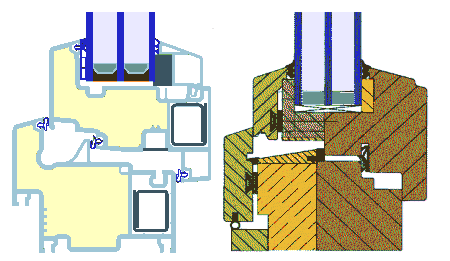
Passivhaus window frame cross-sections showing triple-pane units. The frame insulation and glazing depth both affect whole-window U-factor. Source: Passivhaus Institut, Wikimedia Commons (GFDL / CC BY-SA 3.0).
R-Value: The Inverse of U-Factor
R-value is the thermal resistance of a material or assembly. It is calculated as the reciprocal of U-factor: R = 1/U. A window with a U-factor of 2.0 W/m²·K has a metric RSI value of 0.5 m²·K/W. In the imperial system used informally in the Canadian building trades, this converts to an R-value of approximately 2.8.
R-value is more familiar to many contractors and homeowners because it is widely used for wall and attic insulation. However, windows are routinely specified by U-factor in building codes and ENERGY STAR documentation, so U-factor is the primary metric to track when comparing window products.
Unit conversion: To convert metric U-factor (W/m²·K) to imperial U-factor (BTU/hr·ft²·°F), multiply by 0.1761. To convert metric RSI to imperial R-value, multiply by 5.678. Most product datasheets provide both systems.
How These Values Are Measured
In Canada and the United States, the National Fenestration Rating Council (NFRC) sets the testing and simulation protocol for window thermal ratings. Window manufacturers submit products to accredited simulation laboratories that model the assembly using software conforming to NFRC 100. Physical testing is used for verification and quality control.
The standardized conditions use an indoor temperature of 21°C (70°F) and an outdoor temperature of -18°C (0°F), with defined wind speed and solar radiation values. These conditions represent a cold North American winter scenario. The resulting U-factor is an approximation of real-world winter heat loss under those boundary conditions.
Because the measurement protocol is standardized, U-factors from different manufacturers are directly comparable — provided both products carry NFRC certification. Products without NFRC ratings may use different test conditions, making side-by-side comparison unreliable.
ENERGY STAR Canada U-Factor Thresholds
ENERGY STAR Canada sets maximum U-factor values for each of its five climate zones. Products must meet or exceed the zone threshold to qualify for certification in that zone. A product certified in Zone 1 (mildest) may not qualify in Zone 3 or higher without meeting the stricter performance requirements of those zones.
The following table reflects approximate ENERGY STAR Canada requirements. Always verify current thresholds directly with Natural Resources Canada or the ENERGY STAR Canada product database, as criteria are updated periodically.
| Zone | Representative Areas | Max U-factor (W/m²·K) |
|---|---|---|
| Zone 1 | Southern Vancouver Island, parts of Fraser Valley | 1.80 |
| Zone 2 | Metro Vancouver, southern BC interior | 1.65 |
| Zone 3 | Southern Ontario, Quebec City, Calgary | 1.40 |
| Zone 4 | Northern Ontario, most of Manitoba, Saskatchewan | 1.22 |
| Zone 5 | Yukon, NWT, Nunavut, northern Quebec and Labrador | 1.05 |
Note: values shown are approximate and subject to revision. Confirm current thresholds with NRCan before specifying products.
The Role of the Spacer
The spacer is the component that maintains the gap between glass panes at the edge of an insulated glazing unit. Traditional aluminum spacers are thermally conductive and create a cold edge that degrades overall window performance — this is called edge-of-glass conduction and it accounts for a disproportionate share of heat loss in some units.
Warm-edge spacers made of materials such as stainless steel, foam, or composite materials substantially reduce this effect. High-performance windows certified to Zone 4 and 5 thresholds almost universally use warm-edge spacers. When comparing products, ask the manufacturer whether the whole-window U-factor shown on the NFRC label includes warm-edge spacer geometry, as it should under NFRC 100 methodology.
Reading the Numbers in Practice
When comparing products on a showroom floor or a product datasheet, the most useful immediate check is: does the whole-window U-factor meet the ENERGY STAR threshold for the climate zone where the window will be installed? A product that does not meet this threshold can still be purchased and installed, but it will not qualify for rebates and will deliver lower thermal performance than a certified alternative at the same price point.
Beyond ENERGY STAR thresholds, the difference between a U-factor of 1.2 and 1.0 W/m²·K represents a meaningful improvement in very cold climates. In Zone 5, the increment between a certified triple-pane and a high-performance Passivhaus-standard window (which may reach values around 0.7–0.8 W/m²·K) can be relevant for heavily insulated buildings where the window is the dominant heat loss pathway in the envelope.
Summary of key points
- U-factor and R-value measure the same property. Use U-factor for window comparisons.
- Whole-window U-factor is more relevant than centre-of-glass U-factor alone.
- NFRC certification ensures standardized measurement methodology.
- ENERGY STAR Canada sets zone-specific thresholds; confirm the zone for the installation address.
- Warm-edge spacers reduce edge-of-glass heat loss and improve overall U-factor.
- Very cold zones (4 and 5) typically require triple-pane units with low-e coatings and gas fill to meet certification thresholds.