Glazing Options: Double vs. Triple Pane
Most windows sold in Canada today are either double- or triple-pane insulated glazing units (IGUs). Both consist of two or three panes of glass separated by a sealed air or gas-filled space, which reduces conductive heat transfer compared to single-pane glass.
Triple-pane units have a lower U-factor — meaning less heat loss per square metre per degree of temperature difference — but they are heavier, more expensive, and not always necessary depending on the climate zone. In mild coastal climates such as Metro Vancouver, a high-quality double-pane with a low-emissivity coating often meets ENERGY STAR thresholds. In colder zones like the Prairie provinces, triple-pane units are more commonly required to reach equivalent performance levels.

Double-glazed insulated window unit. The sealed space between panes reduces conductive heat transfer. Source: NcLean, Wikimedia Commons (CC BY-SA 3.0).
Low-Emissivity Coatings and Gas Fills
A low-emissivity (low-e) coating is a microscopically thin metallic layer applied to one surface of the inner glass panes. It reflects long-wave infrared radiation — the heat radiating from interior surfaces — back into the room, reducing heat loss through the window. Low-e coatings are now standard on most energy-rated windows in Canada.
The position of the coating on the glass unit affects performance characteristics. A coating on the third surface (counting from outside) is optimized for cold-climate heat retention. Coatings on the second surface allow more solar heat gain, which can be beneficial in heating-dominated climates where passive solar gain reduces heating loads in winter.
The gap between panes is typically filled with argon or krypton gas rather than air. Both gases are denser than air, which slows convective heat transfer within the unit. Krypton provides slightly better performance in narrower gaps and is used in high-performance triple-pane units where frame depth is constrained.
Note on solar heat gain coefficient (SHGC): In cold climates, a higher SHGC on south-facing windows can reduce heating costs by capturing winter solar energy. In mixed or cooling-dominated climates, lower SHGC values reduce summer cooling loads. ENERGY STAR Canada specifies SHGC requirements by zone and orientation where relevant.
Frame Materials
The frame represents a significant portion of the window's total area and contributes meaningfully to overall thermal performance. The main material categories used in Canadian residential windows are vinyl (PVC), fibreglass, wood, wood-clad, and aluminum with thermal breaks.
| Material | Thermal Performance | Maintenance | Notes |
|---|---|---|---|
| Vinyl (PVC) | Good | Low | Most common in Canadian retrofits; can expand in heat extremes |
| Fibreglass | Very good | Low | Dimensionally stable; higher upfront cost |
| Wood | Good | High | Traditional look; requires periodic painting or sealing |
| Wood-clad | Good | Moderate | Aluminum or vinyl exterior over wood interior |
| Aluminum (thermal break) | Moderate | Low | Common in commercial; thermal break required for residential |
ENERGY STAR Canada Climate Zones
ENERGY STAR Canada divides the country into five climate zones based on heating degree days (HDD). Each zone has different U-factor and, in some cases, SHGC requirements for windows to qualify for the ENERGY STAR label. Zone 1 covers the mildest areas (parts of coastal British Columbia); Zone 3 covers most populated areas including Southern Ontario and Quebec; Zones 4 and 5 cover the coldest regions.
Before selecting a window, confirm which zone your municipality falls in. This determines the minimum U-factor a product must achieve for ENERGY STAR certification. Natural Resources Canada maintains a zone lookup tool on their website. Products that miss the zone threshold by small margins may still be marketed as energy-efficient but will not carry the ENERGY STAR label or qualify for associated rebates.
What to Look for on a Window Label
In Canada, windows sold by members of the Fenestration Association of Canada (FenCan) carry a rating label from the National Fenestration Rating Council (NFRC). This label displays:
- U-factor: whole-window thermal transmittance in W/m²·K (metric) or BTU/hr·ft²·°F (imperial). Lower is better.
- Solar Heat Gain Coefficient: fraction of solar radiation that enters as heat. Between 0 and 1.
- Visible Transmittance: fraction of visible light that passes through. Affects daylighting.
- Air Leakage: measured in L/s·m² or cfm/ft². Lower values indicate a tighter unit.
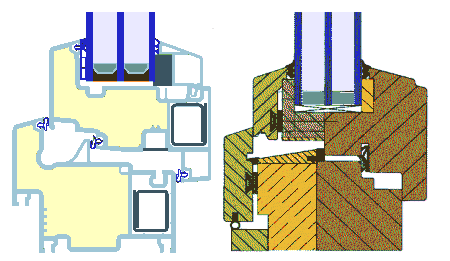
Passivhaus window frame cross-sections illustrating the insulation configurations used in high-performance window systems. Source: Passivhaus Institut, Wikimedia Commons (GFDL / CC BY-SA 3.0).
Practical Considerations Before Ordering
Rough opening dimensions, wall thickness, and existing structural elements all affect which window units are compatible with a given opening. Wider frames accommodate triple-pane glazing but may reduce the visible opening size. In heritage buildings, replacement units may need to match the profile of the original window for permit approval.
Air sealing around the frame is as important as the window's rated performance. A window with an excellent U-factor installed with poor flashing or inadequate backer rod and sealant will underperform relative to its rated specification. The installation process is covered in the Window Installation Standards article.
Provincial rebate programs change periodically. As of this writing, several provinces including Ontario, British Columbia, and Quebec have offered rebates for window upgrades that meet ENERGY STAR criteria, often through utility or government retrofit programs. Check current program availability through provincial energy efficiency agencies or NRCan's Greener Homes resources.
Key questions before selecting a product
- What ENERGY STAR climate zone applies to the property location?
- What is the target U-factor for the zone, and does the product meet or exceed it?
- What is the existing wall assembly, and how does frame depth affect installation?
- Are south-facing windows being specified separately for higher SHGC to capture solar gain?
- Is the installer familiar with the air barrier and flashing requirements in the local building code?